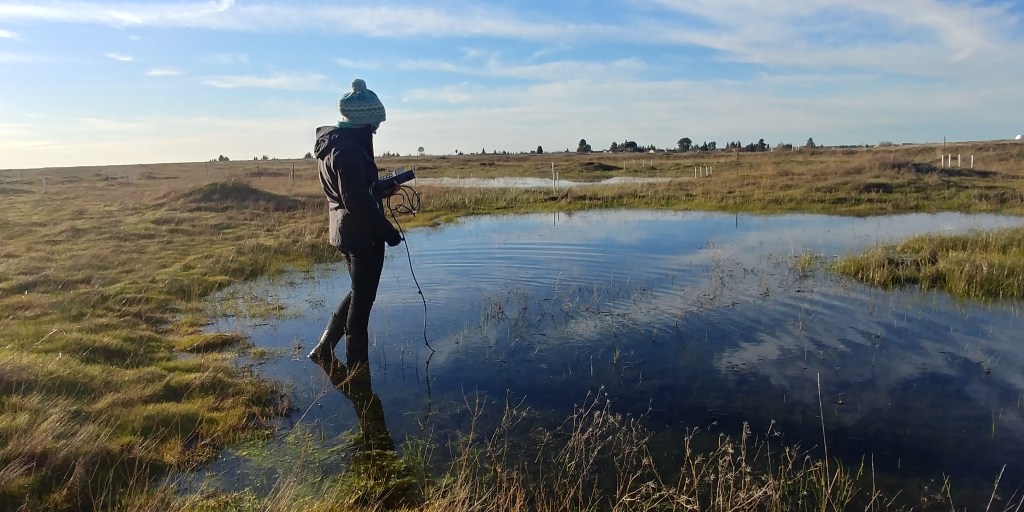
My overarching research goals are to investigate how climatic and human development changes affect natural resources, specifically water resources, and to find ways to mitigate these changes in order to minimize negative impacts on natural systems and human communities.
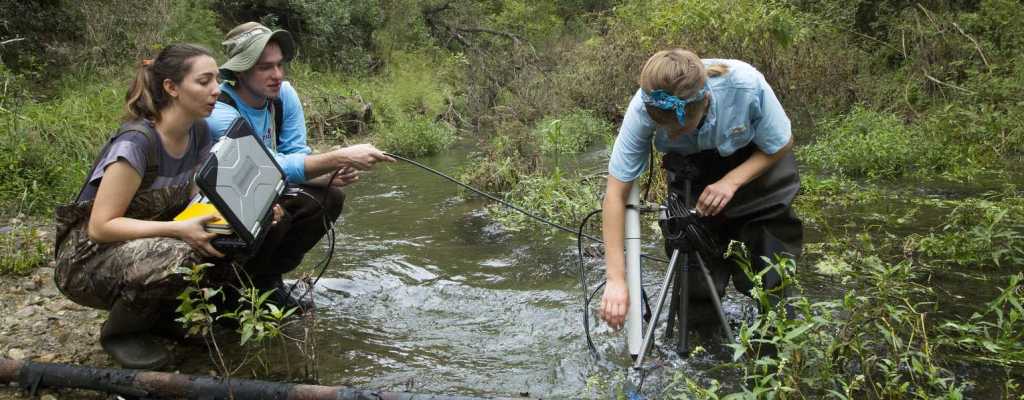
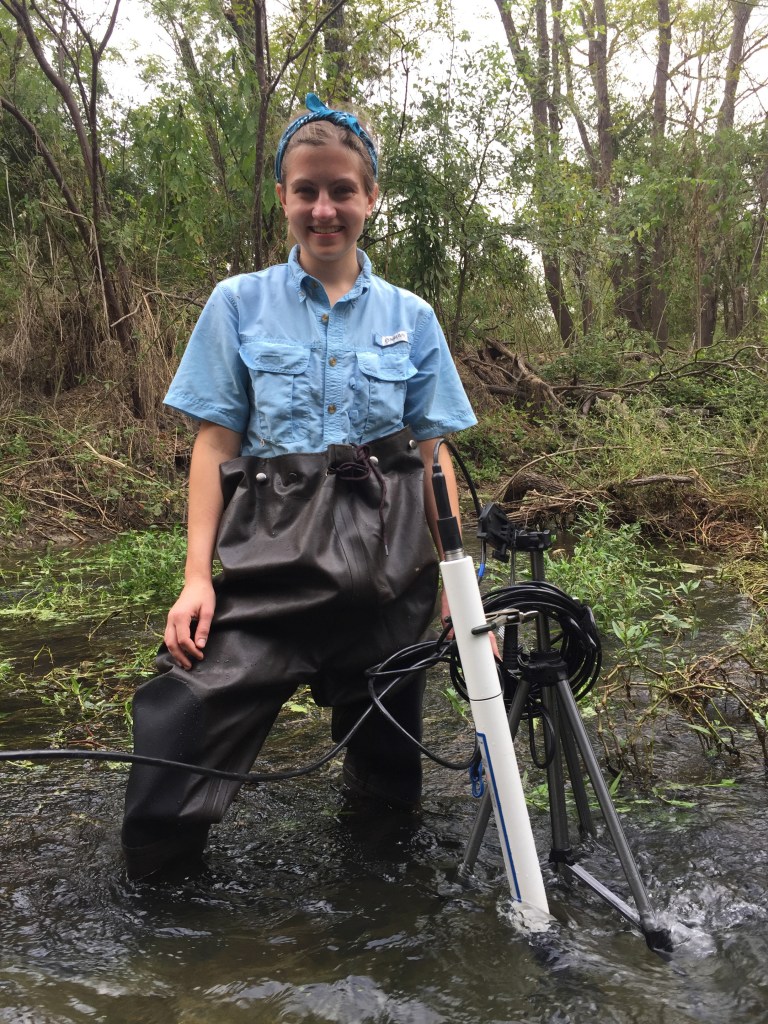
Currently, my research focuses on stream assessments from hydrological and ecological perspectives. My other recent work has involved investigating presence and nature of hydrological connectivity between headwater wetlands and the surrounding hydrological landscape, including downgradient wetlands, streams, and other waters.
My previous work has included utilizing carbonate paleontology, sedimentology, and stratigraphy to characterize carbonate platforms in South China, and conducting groundwater and surface water resource assessments in semi-arid to arid regions throughout Texas and in central Kenya.
Ecohydrology
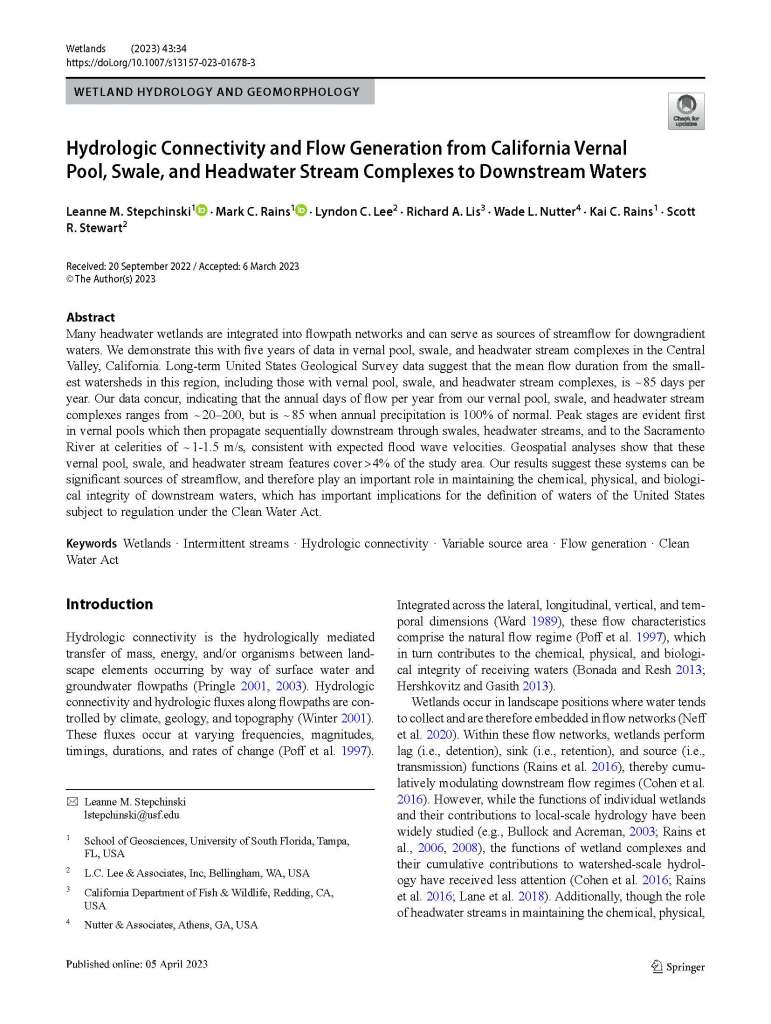
Check out my latest article in Wetlands:
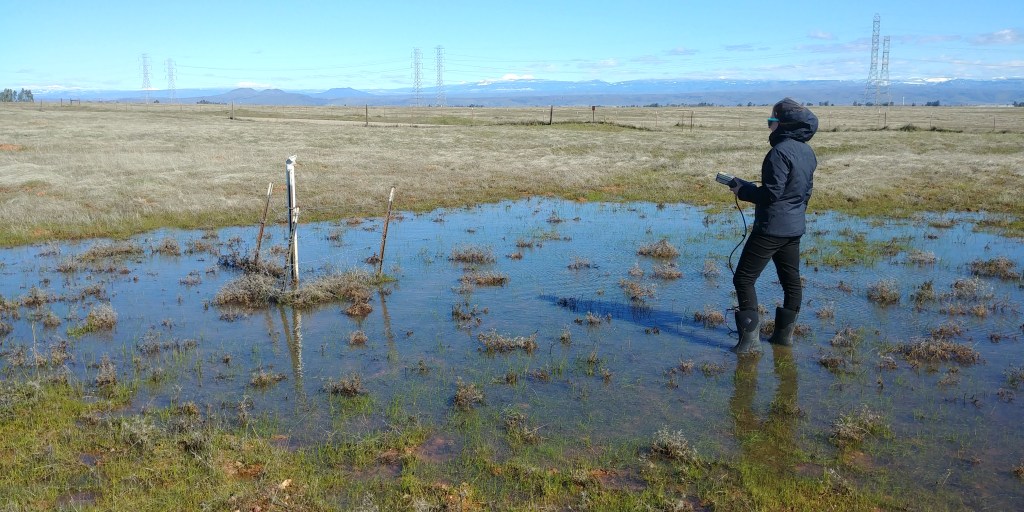
Vernal pool wetlands
I study the presence and nature of hydrologic connectivity between headwater wetlands and downstream waters.
I use a combination of field and modeling studies to investigate how headwater wetlands can impact the natural flow regimes and subsequent integrity of downgradient streams, rivers, and other waters.
Ecohydrology Modeling:
Wetland Overland Routing Model (WORM):
WORM is an an archetypal model that can be used to simulate and analyze cumulative functions of wetland networks of multiple wetlands and flowpaths at the watershed scale. WORM allows for combination of series of individual wetlands and flowpaths, as well as variation of topology (i.e. the spatial arrangement of wetlands and flowpaths), within the landscape.
WORM application: Investigating the Influence of Hydrologic Connectivity on the Natural Flow Regimes of Archetypal Headwater Wetlandscapes
WORM was used to investigate the effects of altering topology in archetypal wetland landscapes on the natural flow regime of downstream waters. WORM was applied to scenarios in which the topology of archetypal wetland networks was varied. Results showed that simulating changes to hydrologic connectivity in the modeled archetypal headwater wetland complexes via altering wetlandscape topology affected characteristics of flows generated and propagated downstream. These results indicate that altering the hydrologic connectivity of headwater wetlandscapes affects the natural flow regimes produced therein, thereby influencing the integrity of downstream waters.
Hydrology and Hydrogeology
Projects:
Assessment of Carrizo-Wilcox Aquifer Groundwater Resources for Wintergarden Groundwater Conservation District
Evaluation of Water Resources for Lewa-Borana Landscape Wildlife Conservancy, Kenya
Development of the Conceptual Model for the Hill Country Trinity Aquifer Groundwater Availability Model for the Texas Water Development Board
Study of Brackish Water Resources of the Trinity Aquifer in Texas for the Texas Water Development Board
Carbonate Sedimentology, Stratigraphy, and Paleontology
Projects:
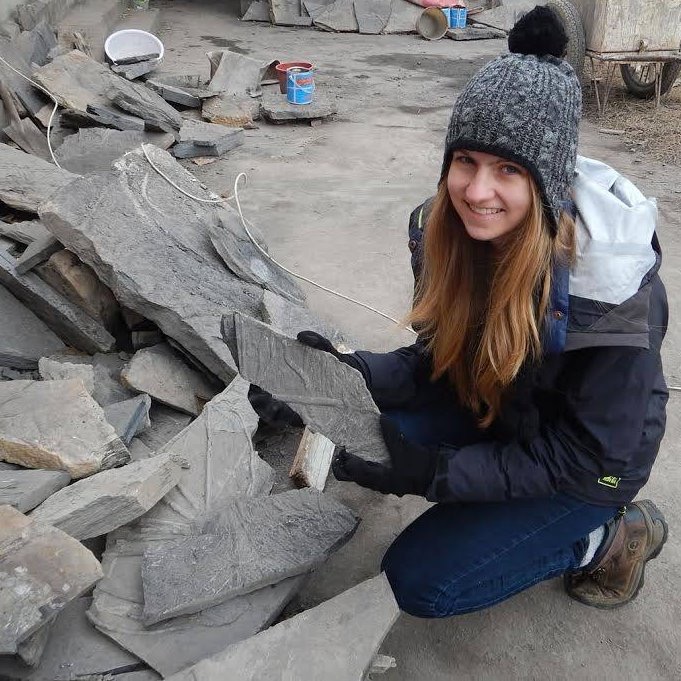
Study on the Controls on Carbonate Factory Type (Abiotic, Microbial, Skeletal) on the Hongyan Margin of the Yangtze Platform, South China
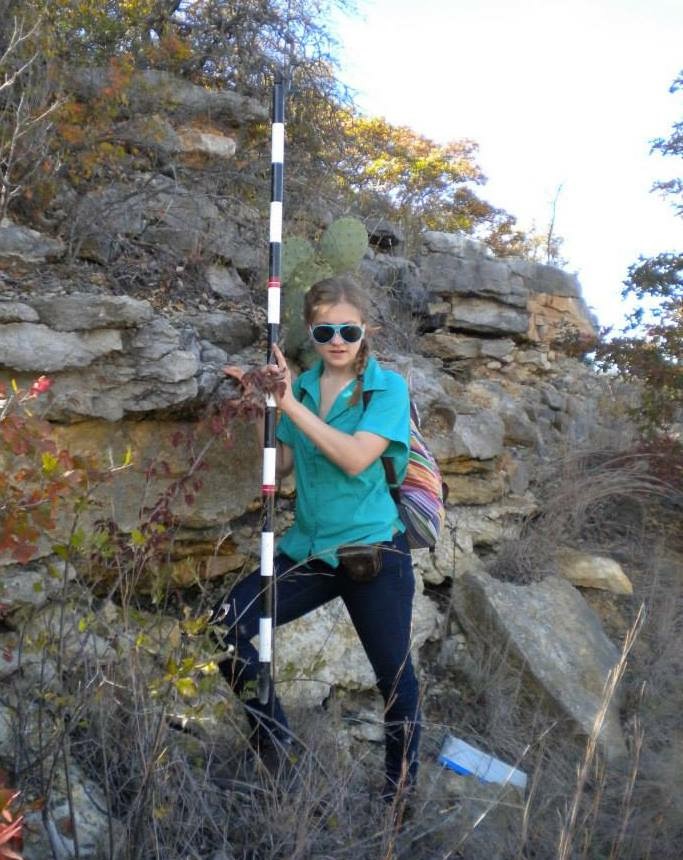
Creation of Integrated Biostratigraphy and Chronostratigraphy for the Permian-Upper Triassic Strata of Guandao Section, Nanpanjiang Basin, South China
Paleoclimate
Projects:
Investigation of Drought Intensity and Periodicity in South Texas
Check out our article in Ecological Indicators:
 Leanne Stepchinski